
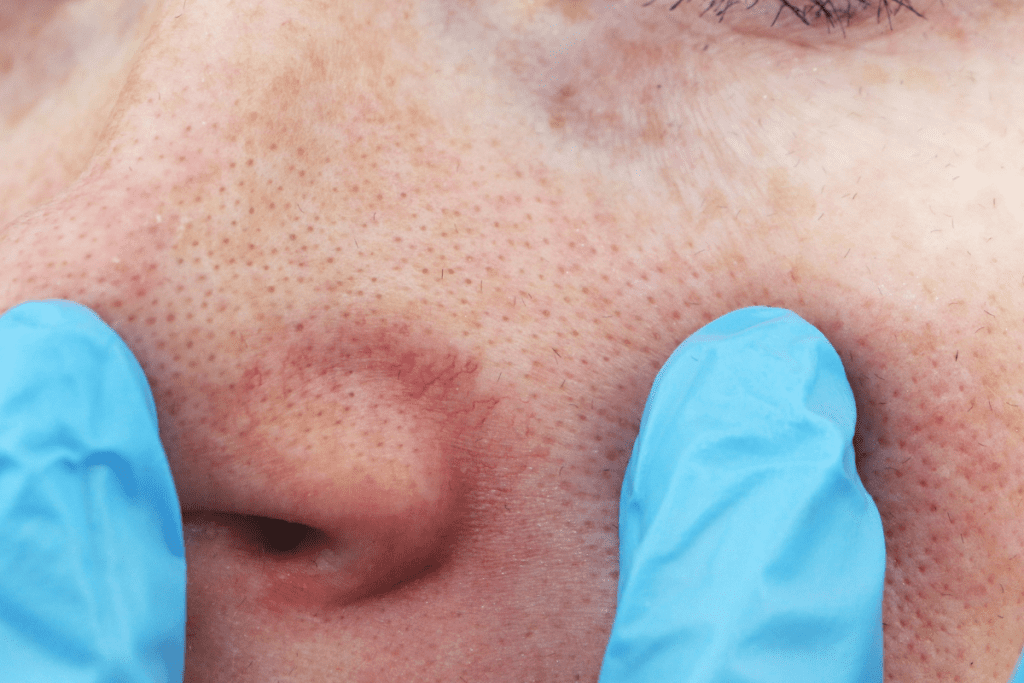
Many professionals have probably noticed a rise in acne and rosacea over the past few years. What most people don’t realize is that, in many cases, wellness supplements are the culprits behind these skin changes. One skin concern in particular has become so widespread that it should be considered an epidemic. When looking closely at people’s skin, you’ll notice that many have redness, bumps, or visible capillaries near their nostrils, both on the sides and on the upper lip. There is a surprising reason behind this, which we’ll explore in this article.
AN EMERGING ISSUE
To be clear, redness on and around the nose has been common among clients for decades. Textbooks often misclassify the capillaries on the sides of the nostrils as sun damage, when in reality, they may be signs of acid reflux damaging the esophagus. Redness on the bridge or top of the nose is also usually tied to esophageal inflammation, most often caused by reflux, candida, or hard alcohol consumption. Fortunately, these issues can be treated holistically once the root cause is identified.
What appears to be a relatively new development is the redness in the crease of the nostrils and surrounding areas. Typically, the redness or capillaries fall within an inch of the nostrils, a pattern we document using skin mapping. Some dermatologists label this as perioral dermatitis or seborrheic dermatitis, even though the location is distinct from the typical presentation of those conditions. As it turns out, digestive tract issues possibly manifest in specific zones on the face, and the area around the nose corresponds to the stomach. So, what is damaging the stomach enough to cause this redness? And why has it become so common?
CAUSE & TREATMENT
Helicobacter pylori, often called H. pylori, is generally believed by physicians to be an infection caught from others, but I see it differently. In my opinion, H. pylori result from an epigenetic shift in our natural microbiome, brought on by exposure to certain medications and supplements. It leads to poor digestion, ulcers, burping, gas, and bloating – symptoms that often trigger excess mucus and candida. And since most acne, rosacea, and perioral dermatitis cases are caused by mucus and candida, it’s no surprise these skin conditions have become more common alongside the rise in H. pylori. So, what can we do about it?
Several commonly used supplements and medications can trigger this issue. Here’s a list of ingredients and substances to avoid:
- Vitamin A (all forms except beta carotene)
- Vitamin B12 (all oral forms—intravenous is okay)
- Probiotics
- Most antibiotics
- Allergy medications
- Acid reflux medications
- Apple cider vinegar
- Alkalinized waters
While doctors typically prescribe weeks of antibiotics to treat H. pylori, the success rate is relatively low. Why? Because people often continue using the supplements and medications that cause the microbiome to shift back into a state that fosters H. pylori – even after antibiotics kill it off. In other words, antibiotics may wipe out the bacterium, but they also disrupt the microbiome enough to allow H. pylori to return.
Although not everyone who takes these medications or supplements will develop symptoms, many people will. It’s important to note that the standard medical tests for H. pylori have an elevated false negative rate, meaning someone could be told they don’t have it when they do. If you have redness or visible capillaries in the stomach zone described above, you likely have H. pylori. Holistic treatment approaches include frequency medicine and a targeted prebiotic.
ELEVATE YOUR THINKING
Take a closer look at your favorite actors and influencers. You’ll start to notice the signs of this condition everywhere. It’s truly become an epidemic. Even more eye-opening: many people don’t even realize they have it, as the redness can be subtle and hidden in the nasal crease. But once it worsens, it becomes obvious. You’ll see countless individuals at their wits’ end, trying to treat it with the wrong tools.
To be clear, this information comes from years of experience advising on thousands of cases. Most doctors won’t be familiar with this perspective, and that’s okay. Don’t let that discourage you. Instead, become an expert yourself – a true holistic skin specialist – and a source of transformation for clients who will trust you for life.

Dr. Ben Johnson founded Osmosis Beauty with a revolutionary approach that is changing the direction of skin care away from excessive exfoliation and renewing the focus on holistic skin strategies and detoxification. He has found that the body and skin are capable of healing themselves with the proper tools and the removal of toxic influences. The product range has created a great deal of excitement in the beauty industry thanks to its unique action and outstanding results. Dr. Johnson has an educational podcast “#askdrben” has created an AI search engine on the Osmosis website for any specific information.
No comments yet. Be the first to comment!





0 Comments