|
Light and bright, fast and effective, from cosmopolitan cities to country
counties, clear and even toned skin is the NOW and WOW factor that clients
seek. It is the skin care professional’s business to support this
aesthetic goal by promoting care and maintenance of healthy skin. How
NOW can this goal be achieved, the WOW in the answer comes from excellent
professional treatments and use of targeted products formulated with performance
ingredients.
An excellent professional treatment is learned and practiced by the skin
care professional through continuing education and qualification by reputable
and responsible organizations. Being dynamic and offering wow in your
professional services comes from creating your personal skill set and
developing yourself in the here and now. Continue to read trade
|
Whole health
skin analysis checklist
A whole health, thorough
skin analysis should include the elements below:
Client’s Name and Contact
Information
Client’s Date of Birth
Client’s Profession/Occupation
Client Expectations (professional
skin care experience and current goals and objectives)
Client’s Medical History
Iincluding current medications and previous treatments)
Client Skin Assessment
(including skin typing, skin moisture content evaluation, skin blood
circulation evaluation, muscle tone evaluation, skin sensitivity
evaluation, sun sensitivity evaluation based on Fitzpatrick skin
typing, skin disorder and imperfection evaluation, ultraviolet examination
[aka Wood’s Lamp evaluation])
Client Lifestyle and
Diet Assessment (including stress level, sleep pattern, exercise,
food allergies, diet restrictions, water consumption discussions)
Client Ethnicity
Client Commitment to
Professional skin care treatments and home care regimens
|
magazines. Attend trade events and meetings to network with aestheticians
like you, dedicated to actively participating in and staying at the top
of the industry. Spend a day shadowing a dermatologist and partner with
him or her if you find your philosophies and treatments are complementary.
Dr. Marcia Glenn, founder and director of Odyssey MediSpa, Marina del
Rey, Calif., recommends aestheticians: 1) develop a skill set, 2) keep
up with the regular processes and practices of your board by working within
the scope of practice for your license, and 3) keep up with the industry,
it is ever changing. Seek and you shall find how to wow yourself and your
clients in your professional skin care treatments.
Use of targeted products formulated with new performance ingredients is
one of the technological sciences behind an excellent professional treatment.
The term performance ingredient is used to differentiate an ingredient
from an active and an inactive ingredient. An active ingredient is a drug
ingredient and an inactive ingredient is a cosmetic ingredient. The ingredient
technologically designed to offer a desired result is identified as the
performance ingredient offering a purposeful action in the product formulation.
This is part of the scientific wow factor at work. Now how do you determine
which targeted wow product to use?
Value in the Client’s Story
Ensuring a safe and effective professional skin care experience begins
with an understanding of any treatment and ingredient contraindications.
In our politically aware society, there are comfortable ways to explore
a client’s medical history, lifestyle, and ethnicity to ensure the
client is not contraindicated or at high risk for injury for the treatment
or ingredients used. Whitney Johnson, a Nevada licensed aesthetician and
national skin care educator, shares one of her top recommendations, “for
all skin care professionals working with a diverse clientele, have knowledge
of what you are working with . . . know that the education is out there
whether you ask someone or seek the education, the worst it can do is
make you a better aesthetician to your clients.”
An excellent professional treatment and use of targeted products formulated
with performance ingredients can best be selected once a whole health,
thorough understanding of the client and their skin analysis is performed
(see sidebar at left). This type of analysis should always include an
understanding of the client’s medical history, lifestyle, and ethnicity.
There is a story to be heard from the client’s history.
Understanding your client’s story will help you achieve the greatest
success. While performing your skin analysis, ask your client about his
or her familial story. Ask about his or her family members, often understanding
familial medical histories will help the skin care professional understand
the client’s medical tendencies. Piece together the parts of the
story to not only build a relationship with your client, but to determine
the best professional skin care program for your client’s skin and
lifestyle. Having the facts and having the knowledge, allows for the preparation
and execution now of successful treatments leading to a desired wow professional
skin care experience both in the treatment room and at home.
America, The Melting Pot
Our clients, like us, are from Europe, Asia, Africa, Australia, South
America, Central America, and places in between. Our story is the American
story, deeply rooted in immigration. As colonies in the 1700s, people
of diverse nationalities and cultures came to a new land. The combination
of different people and heritages forming a united American nationality
and culture created the American melting pot. It is in this historical
melting pot of the world that American skin care professionals work with
many skins
of color.
Skin and Color
Skin color is determined by four primary colors: red, yellow, brown, and
blue. The blood in our bodies and
specifically the oxygenated hemoglobin in the blood produce the red color.
Just as blood is oxygenated, it also releases oxygen. This release of
oxygen by the blood produces the blue color. The yellow color in our skin
is attributed to the presence of carotene. Large amounts of carrot and
squash consumption will lead to a more yellow color in the skin. The skin
color spectrum is complete with the brown color from melanin found in
the melanocyte cells. All skin has a similar number of melanocyte cells,
which produce melanosomes containing melanin. The melanosomes are transferred
to keratinocyte cells. Paler skin will experience a transfer in the stratum
germinativum and stratum spinosum where the melanosomes are smaller, bundled
together and distributed as a package. Darker skin will experience a transfer
in the stratum granulosum where melanosomes are larger and singly distributed.
The determining factor for the amount of brown color rests in the size
and activity of the melanosomes. 1and2 Conducting a client’s whole
health, thorough skin analysis will allow the skin care professional to
better understand the client’s general melanosome activities and
tendencies, which heavily influence pigmentation and concerns.
Light and Bright, Clear and Even
Clear, even toned skin is achieved when the skin is not traumatized and
melanocyte activity remains suppressed. Heat, inflammation, sun exposure,
and hormonal imbalances are examples of skin traumas that will stimulate
the melanocyte activity. This stimulation leads to pigmentation concerns
and uneven skin tones; post inflammatory hyperpigmentation and melasma,
especially in skin of color, are a few examples. Use of lightening and
brightening performance ingredients will help the skin care professional
suppress this melanocyte activity. Laura L. Root, CST and CIDESCO qualified,
author of “The Skin Care Professional’s Chemistry and Ingredient
Handbook, says, “the judicious use of these types of [skin lightening
and brightening] ingredients, in conjunction with sun protection, should
be used prior to the implementation of exfoliating treatments such as
microdermabrasion or chemical exfoliation to reduce any possibility of
stimulating melanocytic activity”.
Success is best achieved when the skin care professional and the client
have an open line of communication about: 1) the time frame these targeted
products formulated with performance ingredients take to work on the skin
and 2) the need for a dedicated, habitual use of the targeted products
formulated with performance ingredients in combination with a daily sun
protection product.
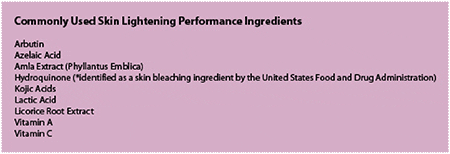
Root believes, “the use of synergistic blends of ingredients, including
the use of licorice root extract, arbutin, azelaic acid, and amla extract
(phyllantus emblica), among others, benefit skin of color in the effort
to eliminate hyperpigmentation.” While these are excellent ingredients,
vitamin A, vitamin C, hydroquinone, and kojic acid are also traditionally
used ingredients for skin lightening and brightening.
New Performance Ingredients for Skin Lightening and Brightening
New performance ingredients for skin lightening and brightening have been
introduced. The clinical studies have shown desired results. Yet it is
important for the skin care professional to carefully and critically examine
the studies. In addition to researching clinical studies on performance
ingredients, the skin care professional must also consider the end formulation
that holds the performance ingredient. As Rebecca James Gadberry, President
and Chairman of the Board, YG Laboratories, Huntington Beach, Calif.,
explains, a performance ingredient’s action depends on the specific
formulation of the product. You will not know the outcome and result of
a targeted product formulated with a performance ingredient until you
put the performance ingredient into the product formulation. The skin
care professional must determine if the final product formulation is successfully
able to deliver the performance ingredient to the skin? Or is the penetration
of the performance ingredient inhibited, therefore nullifying the targeted
result because it was not effectively formulated? Gadberry recommends
skin care professionals “don’t take anything for granted .
. . do your own clinical testing.” She suggests investing in purchasing
the necessary amount of product to run your own test. Select a test population,
have them stop using everything, establish a testing time frame and use
a suggested protocol (a one week minimum is recommended) to perform your
own study.
There are many new skin lightening and brightening performance ingredients.
However, many do not offer the efficacy they claim. Gadberry notes, “most
of the melanin process is known except for the final step . . . if we
continue to look at inhibiting melanin production, it is going to be a
hit or a miss success, we have to unlock the secrets to the steps that
turn the pigment into melanin.” For this reason, it is even more
important for the skin care professional to independently examine targeted
products formulated with skin lightening and brightening performance ingredients
to independently test the results. As Gadberry says, “the proof
is in the pudding.”
|
Considerations
for Careful and Critical
Clinical Study Evaluations
Research the percentage
of performance ingredient used in the study and the acutal aount
of use in a finished formulationl
Research pH limitations
in the formulation
Reserach the number of
participants used for the study
Research the time from
used for the study
Research the competing
interests of the study authors
Ask who is funding the
study
|
As the industry continues to evolve and change, some traditionally used
performance ingredients for skin lightening and brightening are being
traded for other performance ingredients. Root explains one such example,
“the use of hydroquinone has fallen out of favor, and is banned
in Asia, due to a variety of reasons, not the least of which is the tendency
to increase sun sensitivity. Therefore, the use of the ingredients previously
mentioned in combination have been shown to be at least as, if not more,
effective than hydroquinone or even kojic acid, with less irritation and
sensitivity issues, especially for skin of color”.
The evolving technological science behind an excellent professional treatment
utilizing tried, tested and true targeted products formulated with performance
ingredients will positively influence the pigmentary system and clients
will have a greater experience leading to a now and wow desired result.
NOW that’s how you can achieve WOW!
Austine Mah is an Asian American who successfully works with skin of
color, especially her own. She is an accomplished methodologist and facilitator,
dedicated to advancing the understanding of therapeutic skin treatments
through continuing education. Technically knowledgeable, Austine extends
her commitment to excellence and awareness from treatment room to home
care. She regularly consults, educates and writes for the aesthetic industry.
Learn more about Austine at www.austinemah.com.Website
Resources
– State Board Contact Information, http://www.ncea.tv/stateboards.html
– FDA, www.fda.gov
References
1 Pugliese, Peter T. Advanced Professional Skin Care. Bernville, PA: The
Topical Agent, LLC, 2005.
2 Martini, Frederic H. Fundamentals of Anatomy and Physiology. San Francisco:
Benjamin Cummings, 2004.
Author’s disclaimer, for clarity and without implying definition
or political use, the author has chosen to use the term skin of color
and ethnic skin to represent the same subject. Many other terms are available.
|




0 Comments